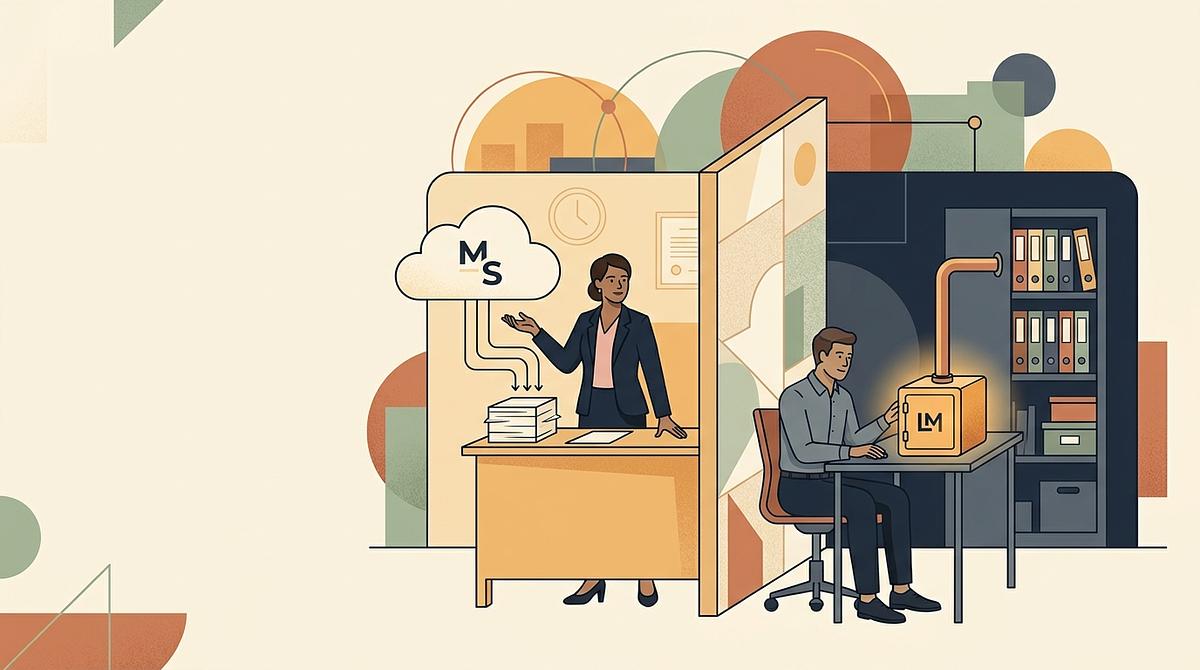
A Tuesday, 5:40 PM, a deed draft to finalize
A clerk is looking for an easement clause they know they've already drafted for a similar file a few years ago. It's somewhere in the office's archive, or in an old Word template. They open three files, ask a colleague for a fourth, and finally find it at 6:20 PM.
Every office knows this lost time. And many are asking the same question: could AI help, without putting professional secrecy at risk?
What Just Changed for the Profession
In early July 2026, the Conseil supérieur du notariat (CSN) announced an eighteen-month partnership with Mistral AI and Scaleway, a French cloud host. It has three parts:
- a conversational agent so offices can get familiar with generative AI;
- a charter recalling the profession's rules: professional secrecy, data protection, GDPR;
- a joint lab to experiment with uses specific to notaries.
Notaries remain free to use these tools or not, and to choose other solutions that respect the charter.
It's a strong signal: the profession isn't saying "don't use AI," it's saying "use it within a framework of trust."
Two Needs Not to Be Confused
Discovering AI. Asking questions, rephrasing a letter, understanding what these tools can do. A general conversational assistant provided by the profession fits this need well.
Working on the office's files. Finding the easement clause, comparing a draft deed to a house template, checking that no document is missing before the appointment. For that, the AI must have access to the office's documents. And that's exactly where secrecy becomes a serious question: the more access the tool has to your files, the more it matters where they are processed.
What Offices That Move Forward Calmly Do
They ask three questions before connecting an AI to their documents:
- Where does the model run? In an online service, on a qualified host, or inside the office?
- Who sees what? A colleague must stay limited to the files open to them; the AI must not bypass those rights.
- Can we prove what happened? Every request must be logged: who asked what, and when.
They also read the profession's charter before any deployment. It's the right reflex, whatever the tool.
Where LMbox Fits
LMbox is an appliance installed in your office. The AI model runs on your premises: no file is sent to a third party. It works on the documents you give it, cites the source of each answer, respects your existing access rights and logs every request.
It doesn't replace your deed-drafting software and it doesn't replace the notary: the AI prepares, the notary reviews and signs.
Many offices will start with the profession's assistant to get familiar. Those who then want to save time on their own files will need a tool that knows them.
Next step: if you want to see what this looks like on a sample of your documents, request a demo — 30 minutes, no commitment. You can also see our page dedicated to notary offices.