The Associate Who "Just Summarized the Opposing Exhibit"
On a Monday morning, an associate tells you they saved two hours: they pasted the opposing exhibit, forty pages, into an online AI tool to get a summary. The summary is pretty good.
You have two reactions at once: that's efficient, and what just happened to that document?
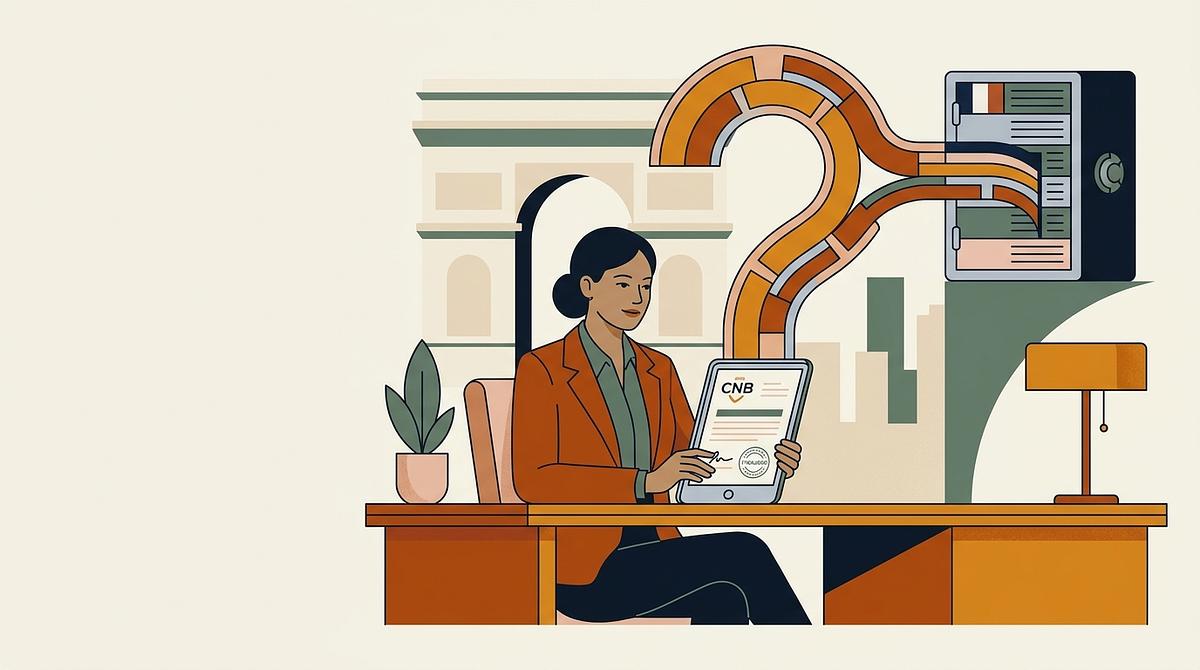
This scene plays out in many firms today. The French Conseil national des barreaux (CNB) guide on AI is there to answer it.
What the CNB Guide Says
On March 17, 2026, the CNB adopted a guide on ethics and artificial intelligence. Its line is clear, and not the one you'd expect:
- generative AI is not banned, it is framed;
- the lawyer keeps control and responsibility: they verify what the tool produces;
- professional secrecy and GDPR apply as before;
- no identifiable client data should be sent to a service that doesn't guarantee absolute confidentiality.
In other words: using AI isn't the problem. What matters is what you give it to read, and where it is processed.
The Real Question: Where Does the Document Go?
When your associate pastes an exhibit into an online service, that document is sent to a provider, processed on its servers, in a country and under conditions the firm doesn't always control. For a lawyer, that's not a technical detail: it's the question of secrecy.
There are broadly three ways to answer it:
- Ban it. Easy to say, hard to enforce: people come back to it on their personal phones.
- Anonymize before every use. It takes time and rigor every time, and a single omission is enough.
- Use a tool that processes documents in-house. The document doesn't leave the firm; the question of transmission to a third party no longer arises.
What Firms That Move Forward Calmly Do
They ask four questions before choosing a tool:
- Where does the model run? Online, at a host, or inside the firm?
- Who sees what? Files must stay compartmentalized, notably for conflicts of interest.
- Can the method be documented? A record of what was asked, by whom, and when.
- Who verifies? Every answer must cite its sources, so the lawyer can check.
They also read the CNB guide in full. It's the best starting point, whatever tool they choose.
Where LMbox Fits
LMbox is an appliance installed in your firm. The AI model runs on your premises: no client file is sent to a third party. It works on the firm's documents, cites the source of each answer, respects existing access rights and logs every request.
It is not a case-law database: it doesn't replace your legal publisher, it makes use of what the firm already owns, its files, memos and templates.
The AI prepares. The lawyer verifies, decides and signs.
Next step: to see what this looks like on a sample of your documents, request a demo — 30 minutes, no commitment. You can also see our page dedicated to law firms.